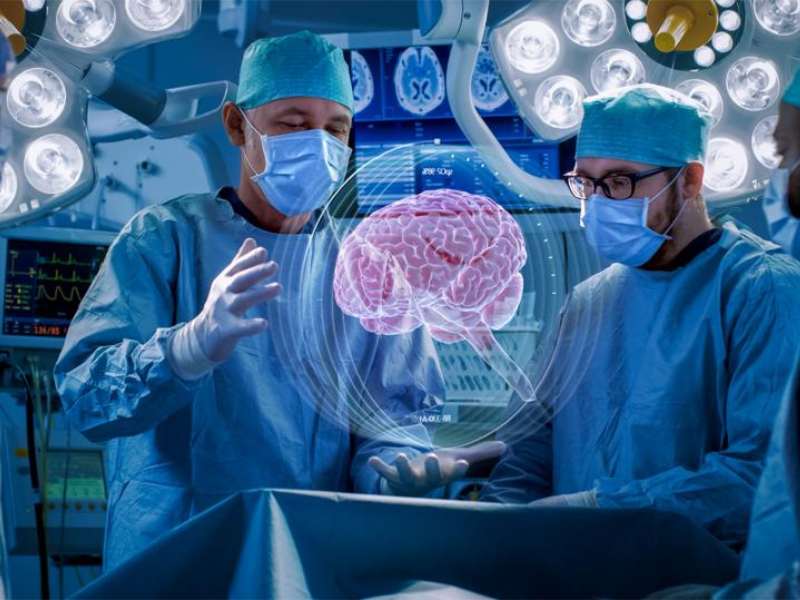
Imagine a neurosurgeon peering through a headset where the skull becomes translucent, blood vessels glow in soft blue, eloquent cortex — the regions governing speech, movement, and memory — is shaded in cautionary red, and the tumor nestled three centimeters beneath the surface is outlined with millimeter precision. This is no longer science fiction. In hospitals from Munich to Toronto to Seoul, this is Tuesday morning.
Augmented reality (AR) in neurosurgery represents one of the most consequential technological leaps since the introduction of the operating microscope in the late 1950s and 1960s. By overlaying digitally reconstructed anatomical data directly onto a patient's actual anatomy in real time, AR systems promise to do what no previous tool could: let surgeons see what they cannot physically see, while still operating with their own hands.
The market reflects this momentum. AR-guided surgery is projected to grow into a multi-billion dollar global industry within the decade, driven by device manufacturers, hospital systems, and a generation of surgeons who trained with screens before they trained with scalpels. Landmark studies published between 2022 and 2025 have begun establishing the clinical evidence base, and several systems have now received FDA breakthrough device designation — the agency's fastest regulatory pathway for transformative technologies.
Neurosurgery is unforgiving in a way few other disciplines are. A misplaced incision in orthopedic surgery may cause pain. A misplaced incision in the brain may end a patient's ability to speak, to move their right hand, to recognize their spouse's face. The stakes are existential and the margin for error is measured in fractions of millimeters.
Traditionally, surgeons rely on a mental 3D model stitched together from preoperative MRI and CT scans — static images that bear increasingly little resemblance to the brain once the skull is opened and tissue shifts under gravity and cerebrospinal fluid drainage. This phenomenon, called brain shift, can displace critical structures by anywhere from a few millimeters to more than 25 millimeters depending on the case, rendering preoperative imaging dangerously misleading during the actual resection.
Brain shift has been one of neurosurgery's most persistent unsolved problems. Standard neuronavigation systems — essentially GPS for the brain — are calibrated against preoperative scans. Once tissue moves, those systems lie. AR platforms that integrate intraoperative ultrasound or MRI can continuously update the overlay model, tracking deformation in real time and keeping the virtual map honest.
Beyond brain shift, the case for AR visualization rests on the sheer density of what must be tracked and preserved simultaneously. A single cortical resection may require the surgeon to mentally hold the positions of the corticospinal tract, the arcuate fasciculus, the middle cerebral artery and its perforators, the tumor's true margin versus its imaging margin, and the location of previously mapped eloquent cortex. AR externalizes this cognitive burden into the visual field.
Building an AR neurosurgery system requires solving a cascade of difficult engineering problems — each one of which, if unsolved, could make the entire system useless or dangerous. A complete AR pipeline begins with preoperative imaging inputs — MRI, CT, functional MRI, and digital subtraction angiography — which are fed into deep learning segmentation models such as nnU-Net and 3D-UNet to produce a detailed 3D anatomical reconstruction. This model is then registered to the patient's physical anatomy using iterative closest-point algorithms combined with electromagnetic instrument tracking. The entire system must maintain end-to-end latency below 30 milliseconds with registration accuracy under 2 millimeters to be clinically viable.
Before any overlay can be generated, the preoperative MRI and CT scans must be parsed into meaningful 3D structures — tumor, vein, artery, eloquent cortex, ventricle. This segmentation task is where deep learning has been transformative. Convolutional neural networks trained on thousands of annotated neuroimaging datasets can now delineate glioblastoma margins, arteriovenous malformation niduses, and peritumoral edema in minutes — tasks that previously required hours of manual radiologist time.
Perhaps the hardest problem is registration — mapping the reconstructed 3D model onto the patient's actual anatomy with sufficient precision to be clinically useful. Early systems used skin-affixed fiducial markers. Modern approaches use surface-based registration, scanning the patient's exposed cortex with structured light and matching it to the segmented model using iterative closest-point algorithms. Electromagnetic tracking coils embedded in surgical instruments provide real-time positional data, achieving spatial calibration accurate to within 1–2 millimeters.
Two display paradigms dominate clinical AR neurosurgery today. The first uses mixed reality headsets — Microsoft's HoloLens 2 is the most widely deployed platform — where the surgeon sees the real world with holographic overlays. The second integrates AR directly into the surgical microscope's optics, so virtual structures appear to exist within the tissue being magnified. Headsets offer mobility and hands-free interaction; microscope integration provides higher optical resolution and better depth perception within the magnified field.
Key constraint: Any perceivable lag between head movement and overlay update creates spatial disorientation. Clinical AR systems must maintain end-to-end latency below 20–30 milliseconds — a target that pushes the limits of wireless streaming, GPU rendering, and display refresh rates simultaneously.
High-grade gliomas present a cruel dilemma: the more aggressively a surgeon resects, the better the survival outcome, but the higher the risk of neurological deficit. AR is shifting this tradeoff. By providing sub-millimeter overlay of tumor margins derived from advanced MRI modalities — perfusion, spectroscopy, tractography — surgeons can pursue maximal safe resection with greater confidence. Some centers report achieving gross total resection rates that were previously unattainable without unacceptable deficits.
AVMs are tangles of malformed blood vessels that can lurk silently until a catastrophic bleed. Their surgical treatment is notoriously difficult: the feeding arteries and draining veins must be identified and eliminated in precise sequence, or the nidus can rupture intraoperatively. AR systems that reconstruct angiographic data into color-coded 3D vascular maps are increasingly being reported as valuable tools in this context. A 2024 study published in Neurosurgical Focus by Najera et al. described a 10-patient AR-assisted AVM series in which mixed reality significantly facilitated identification of deep arterial feeders that would otherwise have been difficult to localize. Separately, surgeons at Mass General Brigham have been developing AR-guided AVM techniques at scale, with a 140-patient outcomes series in preparation. The literature is still maturing, and larger controlled studies are needed before definitive conclusions can be drawn — but early results are encouraging.
Some tumors sit so close to speech or motor areas that surgeons perform the resection while the patient is conscious and responding to commands. AR platforms can overlay functional mapping data generated in real time by electrocorticography electrodes, showing the surgeon exactly where a language site was just confirmed — updated live as the brain responds. Surgeons describe this as a "live, surgical conscience," a constant reminder of what must not be touched.
Some of the most impactful AR applications have emerged in skull base surgery, where surgeons must navigate complex three-dimensional corridors between cranial nerves, carotid arteries, and venous sinuses. AR navigation has been applied to acoustic neuroma removal, pituitary tumor resection, and petroclival meningioma surgery — reducing cranial nerve injury rates in several reported series.
AR in neurosurgery is not a destination — it is a platform onto which other transformative technologies are being loaded. The next decade promises a convergence that may make current AR systems look primitive by comparison.
Intraoperative AI will continuously re-segment and re-register anatomy as the surgeon operates, updating the overlay model with each image acquired by an integrated ultrasound probe — effectively eliminating registration drift over the course of a long resection.
Robotic surgical systems like ROSA Brain and Modus V are being designed to receive AR-generated waypoints and no-go zones, creating a cooperative framework where human judgment and robotic precision reinforce each other in real time.
Expert surgeons in one city will guide residents elsewhere through complex glioma resections by drawing directly in the AR overlay — literally pointing to structures in the operating field from thousands of miles away.
5-ALA fluorescence, EGFR-targeted contrast agents, and Raman spectroscopy probes will feed real-time molecular data into the AR overlay — showing not just where the tumor is, but how biologically aggressive each region is.
The most speculative but tantalizing frontier is the integration of electrophysiological data — signals from electrodes placed directly on the cortex — into live AR overlays. Prototype systems have demonstrated this in laboratory settings, and the translation pathway to clinical use is now a matter of engineering refinement, not fundamental science.
Technology has a troubling tendency to amplify existing disparities before it democratizes them. The history of robotic surgery — where Intuitive Surgical's da Vinci became a prestige purchase for wealthy hospital systems while adding little proven clinical benefit in many procedures — is a cautionary tale AR neurosurgery must reckon with seriously.
The neurosurgical burden of disease is not evenly distributed. Sub-Saharan Africa accounts for a disproportionate share of the world's traumatic brain injuries, brain tumors, and hydrocephalus, yet the ratio of neurosurgeons to population across Africa as a whole is approximately 1 per 679,000 — and in regions like East Africa, closer to 1 per 9 million — compared to roughly 1 per 62,500 in the United States. AR technologies that cost half a million dollars installed, require continuous cloud connectivity, and demand a trained biomedical engineer for maintenance are not going to help these patients.
There are reasons for cautious optimism. Smartphone-based AR navigation platforms — requiring only a calibrated phone camera and a cloud-rendered model — have been demonstrated in proof-of-concept studies to achieve surprisingly acceptable registration accuracy for simpler procedures. The question is whether the field will actively choose equity, or settle for it as a belated afterthought once the profitable tier of the market is saturated.
There is something almost philosophical about what augmented reality does in the neurosurgical theater. The brain — the seat of consciousness, memory, identity, everything a person is — has always been the final internal territory, the one place even the most invasive surgeon could not truly see directly. We have worked around it, inferred it, modeled it from the outside and guessed at its interior. AR changes the phenomenology of this encounter. For the first time, the surgeon and the brain's structure occupy the same visible space.
This is not merely a technical achievement. It is a realignment of the human relationship with the organ that defines what being human means. The neurosurgeon working with an AR overlay is doing something no surgeon before the twenty-first century could do: operating with knowledge about where they are that approaches — even if it does not yet reach — the precision the task has always demanded.
The remaining challenges are real and should not be minimized. Registration drift, cognitive overload, regulatory friction, and global inequity are not minor friction — they are the difference between a technology that transforms neurosurgery for everyone and one that polishes already-excellent outcomes at a handful of elite institutions. But the trajectory is clear. The question of whether AR will become standard in neurosurgery has been answered. The questions now are when, how fast, and for whom.
And the answer we choose to those last two words may matter as much as the technology itself.
For patients in Kerala seeking advanced neurological care, access to surgeons trained in these emerging technologies is increasingly available closer to home. The best neurosurgeons in Kochi are now integrating modern neuronavigation and minimally invasive techniques into everyday practice — whether for complex brain tumour resections, spine treatment in Kochi, or skull base procedures. If you are looking for a neurosurgeon in Kochi for brain or spine conditions, consulting a specialist familiar with the latest AR-assisted and image-guided surgical methods can make a meaningful difference in outcomes.
Have a spine or nerve concern? Connect
with Dr. Anup P Nair for clear and personalized guidance.