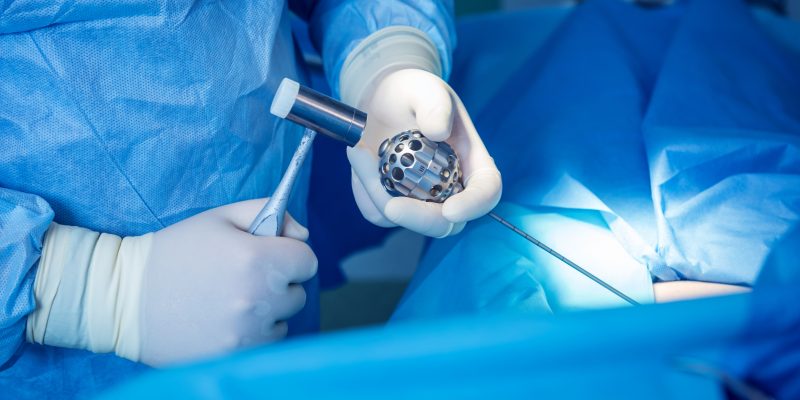
For decades, patients diagnosed with a herniated disc faced a difficult choice: endure months of conservative treatment that might not work, or undergo open spine surgery with a lengthy, painful recovery. Today, that choice looks very different. Endoscopic spine surgery has revolutionized the way disc herniations are treated — offering patients a highly precise, minimally invasive alternative that addresses the root cause of their pain through an incision smaller than a centimeter.
This isn't a compromise. It's an advancement. For appropriately selected patients, endoscopic discectomy delivers outcomes comparable — and in many cases superior — to traditional open surgery, with a fraction of the tissue disruption, blood loss, and recovery time. Patients are often walking the same day and returning to light activities within days, not months.
In this article, we'll walk you through everything you need to know about endoscopic spine surgery for disc herniations: what it is, how it works, who is a candidate, and what you can realistically expect before, during, and after the procedure.
To appreciate why endoscopic surgery is so effective, it helps to understand exactly what a disc herniation is and why it causes such significant pain and neurological symptoms.
Your spine is made up of 33 vertebrae stacked on top of one another. Between each pair of vertebrae sits an intervertebral disc — a tough, fibrous outer ring called the annulus fibrosus surrounding a soft, gel-like center called the nucleus pulposus. These discs act as shock absorbers, distributing load evenly across the spine and allowing for the flexion, extension, and rotation we rely on every day.
A disc herniation occurs when the outer annulus develops a tear or weakness, allowing the inner nucleus to bulge outward or rupture completely. This displaced disc material can press directly against the nearby nerve roots or, in severe cases, the spinal cord itself. The result is the pain, numbness, tingling, and weakness that characterize radiculopathy — most commonly experienced as sciatica when it occurs in the lumbar spine, or arm pain and weakness when it occurs in the cervical spine.
Endoscopic spine surgery is a form of minimally invasive spinal surgery that uses a thin, tube-like instrument called an endoscope — equipped with a high-definition camera and a working channel for surgical instruments — to access and treat spinal pathology through a very small incision, typically 8 to 10 millimeters in length (less than half an inch).
Unlike traditional open surgery — which requires a large incision, significant muscle retraction, and sometimes removal of bone to gain access to the affected disc — endoscopic surgery navigates to the target using real-time fluoroscopic (X-ray) and endoscopic visualization. The surgeon works through a dilating system of tubes that gently separate, rather than cut through, the surrounding muscles and soft tissues.
Once the endoscope is positioned at the disc level, the surgeon uses specialized micro-instruments to remove the herniated disc material that is compressing the nerve — a procedure called an endoscopic discectomy. The nerve is then visually confirmed to be fully decompressed before the instruments are removed and the small incision is closed with a single stitch or surgical adhesive.
Understanding the differences between endoscopic and traditional open discectomy helps patients make informed decisions about their care. The contrasts are significant across nearly every dimension of the surgical experience.
In terms of incision size alone, endoscopic surgery requires only an 8–10 mm opening — less than half an inch — compared to the 3–6 cm incision typical of open surgery. This difference in tissue disruption cascades into virtually every downstream outcome. Because endoscopic surgery dilates rather than cuts through the paraspinal muscles, blood loss is minimal (often less than 20 mL), post-operative pain is significantly reduced, and the risk of surgical site infection is very low.
From a practical standpoint, the differences in recovery are equally striking. Endoscopic discectomy is performed as an outpatient procedure — patients go home the same day. Most are walking within hours of surgery and return to light activity within days to a week. By contrast, traditional open surgery typically requires a hospital stay of one to three days, with return to light activity taking four to six weeks and full recovery often stretching to three months or more.
Anesthesia requirements also differ. Many experienced endoscopic spine surgeons perform the procedure under local anesthesia with conscious sedation rather than general anesthesia — reducing the physiological demands on the patient and enabling real-time neurological feedback during surgery. Traditional open surgery almost universally requires general anesthesia.
For many patients, understanding exactly what happens during the procedure alleviates anxiety and builds confidence in the treatment plan. Here is a detailed walkthrough of the endoscopic discectomy process:
You will arrive at the surgical center and be greeted by the surgical team. An IV line is placed, vital signs are monitored, and the surgical site is cleaned and marked. Depending on the approach and patient preference, either local anesthesia with conscious sedation or general anesthesia is administered. Many experienced endoscopic spine surgeons prefer local anesthesia, as it allows the patient to provide real-time feedback if a nerve is being approached — an additional layer of safety not available in open surgery under general anesthesia.
You are positioned carefully on the operating table — typically prone (face-down) for lumbar procedures. The surgeon uses live fluoroscopy (real-time X-ray imaging) to identify the precise disc level and plan the trajectory of the endoscope. A guide wire is placed through the skin to the target area, followed by sequential dilators that gently create a working channel through the tissue.
The endoscope — a rigid tube approximately 7–8 mm in diameter with a built-in camera, light source, irrigation channel, and working channel — is inserted over the dilators. The high-definition camera transmits a magnified view of the surgical field to monitors in the operating room, giving the surgeon an exceptionally detailed view of the disc, nerve root, and surrounding structures.
Using micro-forceps, laser energy (in some techniques), radiofrequency tools, and other specialized instruments passed through the working channel, the surgeon precisely removes the herniated disc material that is pressing on the nerve. The goal is complete decompression of the affected nerve root while preserving as much of the healthy disc and surrounding structures as possible.
Once decompression is confirmed under direct visualization — the surgeon can see the nerve root moving freely without compression — the endoscope and instruments are removed. The small skin incision requires only a single suture or surgical glue to close. A small bandage is applied. The entire procedure typically takes 45 minutes to 1.5 hours depending on complexity.
You are moved to the recovery area where you are monitored for 1–2 hours. Most patients are able to walk short distances before leaving the surgical center. Detailed discharge instructions are provided, and most patients go home the same day as surgery.
Endoscopic spine surgery is not the right solution for every spinal condition, but it is an excellent option for a well-defined group of patients. A thorough evaluation by a fellowship-trained spine specialist is essential to determine candidacy. The following factors are associated with favorable candidacy:
The benefits of endoscopic spine surgery extend far beyond a smaller scar. The minimally invasive nature of the procedure has meaningful downstream effects on nearly every aspect of the surgical and recovery experience:
One of the most frequently asked questions from patients considering endoscopic spine surgery is: "How long until I feel better?" While individual recovery varies based on the severity of nerve compression before surgery, age, overall health, and adherence to post-operative instructions, here is a general timeline most patients can expect:
Most patients walk within hours of the procedure. You will be discharged home the same day with oral pain medication, activity restrictions, and wound care instructions. Expect some soreness at the incision site and mild residual back discomfort as the local anesthesia wears off.
Many patients notice significant improvement in their leg or arm pain almost immediately — this is the nerve decompression working. You are encouraged to walk short distances multiple times daily. Light household activities are generally permitted. Avoid bending, twisting, lifting more than 5–10 lbs, and prolonged sitting.
Most patients are walking comfortably, sleeping better, and managing well with over-the-counter pain relief or minimal prescription medication. A formal physical therapy program is typically initiated during this phase, focusing on core stabilization, posture, and spinal mobility.
The majority of patients are back to most normal daily activities. Sedentary workers typically return to the office. Physical therapy continues with progressive strengthening exercises. Driving is usually permitted by this stage.
Full recovery, including return to physically demanding activities, sports, and heavy manual work, is typically complete. Continued core and back strengthening exercises are strongly encouraged to reduce the risk of recurrence.
All surgical procedures carry some degree of risk, and endoscopic spine surgery is no exception. However, the complication profile for endoscopic discectomy is generally favorable compared to open surgery. A thorough informed consent discussion with your surgeon will cover all relevant risks specific to your case. General risks associated with endoscopic spine surgery include:
Endoscopic spine surgery is a technically demanding procedure with a significant learning curve. Outcomes are strongly correlated with surgeon experience and case volume. When evaluating a spine surgeon for endoscopic discectomy, patients should look for the following credentials and characteristics:
Endoscopic spine surgery represents the convergence of surgical precision, advanced imaging technology, and a deep understanding of spinal anatomy. For patients suffering from disc herniation-related pain, numbness, or weakness, it offers a path to lasting relief that was simply not available a generation ago.
The days of choosing between "living with the pain" and "major back surgery with months of recovery" are increasingly behind us. Endoscopic discectomy has redefined what's possible — and what patients should expect — from modern spine care.
If you've been diagnosed with a disc herniation and are wondering whether endoscopic surgery might be right for you, we invite you to schedule a consultation with our fellowship-trained spine specialists. We will review your imaging, listen to your goals, and provide an honest, individualized assessment of your treatment options — surgical and non-surgical alike.
Most endoscopic discectomy procedures take between 45 minutes and 1.5 hours, depending on the complexity of the herniation and the number of levels being treated.
Most patients report significantly less post-operative pain compared to open surgery. Discomfort at the incision site is mild and typically managed with oral pain medication. The radicular (leg or arm) pain usually improves dramatically within the first few days after surgery.
Published clinical studies report good to excellent outcomes in approximately 85–90% of appropriately selected patients, with success rates comparable to traditional open microdiscectomy.
Yes, recurrent disc herniation is possible, occurring in approximately 5–10% of cases. Maintaining a healthy weight, avoiding heavy lifting immediately post-operatively, and committing to a core strengthening program significantly reduces this risk.
Most patients are cleared to drive within 2–4 weeks of surgery, once they are off narcotic pain medications and can perform an emergency stop comfortably. Your surgeon will provide specific guidance based on your recovery progress.
Many insurers cover endoscopic spine surgery when it is medically necessary and conservative treatment has been attempted. Coverage varies by plan and provider. Our billing team can help verify your benefits and obtain pre-authorization prior to your procedure.
Have a spine or nerve concern? Connect
with Dr. Anup P Nair for clear and personalized guidance.