When most people hear “Deep Brain Stimulation,” they think of Parkinson’s disease. And for good reason — DBS has been a game-changer for Parkinson’s patients for over three decades. But what if I told you that this remarkable technology is now rewriting the rules of modern neurology, reaching far beyond movement disorders into the realm of mental health, epilepsy, and chronic pain?
During my practice at Aster Medcity Kochi, one of the leading neurosurgery hospitals in Kochi, I have witnessed first-hand how DBS is transforming the lives of patients who once had few — or no — options left. This post explores where DBS stands today and why the future of this technology is perhaps the most exciting frontier in neuroscience.
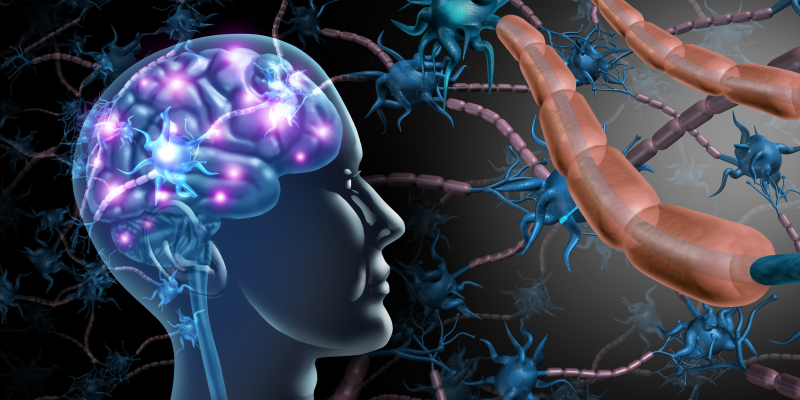
Deep Brain Stimulation is a neurosurgical procedure in which small electrodes are implanted into precisely targeted areas of the brain. These electrodes are connected to a neurostimulator — a small device placed under the skin near the collarbone — that delivers controlled electrical pulses to regulate abnormal brain activity.
Think of it like a pacemaker, but for the brain. Instead of regulating a heartbeat, it modulates the electrical signals in specific neural circuits that are misfiring or overactive.
The procedure is performed under detailed imaging guidance and, in many cases, with the patient awake — allowing the surgical team to receive real-time feedback and place electrodes with exceptional precision. At Aster Medcity, our team uses state-of-the-art neuroimaging and intraoperative monitoring to ensure the safest and most effective outcomes for every patient.
The most well-established use of DBS remains in Parkinson’s disease, particularly for patients whose symptoms — tremors, rigidity, slow movement — are no longer adequately controlled by medication. In these cases, DBS targeting the subthalamic nucleus (STN) or the globus pallidus internus (GPi) has shown dramatic results: reduced tremors, improved mobility, and a significantly better quality of life.
However, it is important for patients and families to understand that DBS does not cure Parkinson’s. It manages symptoms effectively, often allowing patients to reduce their medication dosage and the associated side effects. The decision to proceed with DBS involves careful patient selection, thorough neurological evaluation, and an honest, detailed conversation about expectations.
This is precisely why knowing when to consult a neurosurgeon in Kochi matters. Early consultation — before symptoms become severely debilitating — opens more treatment options and leads to better surgical outcomes.
What is truly exciting today is how DBS is being applied — and studied — for a growing range of neurological and psychiatric conditions.
Dystonia is a movement disorder characterised by involuntary, sustained muscle contractions that cause repetitive or twisting movements. It can be severely disabling and, in many cases, does not respond well to medications.
DBS targeting the GPi has shown remarkable efficacy in both primary generalised dystonia and cervical dystonia. Unlike Parkinson’s disease where benefits are often felt immediately after stimulation, dystonia patients may experience gradual improvement over weeks to months — a distinction that requires careful patient counselling and follow-up.
For patients with drug-resistant epilepsy — those who continue to have seizures despite trying multiple medications — DBS is now an approved and growing treatment option. Stimulation of the anterior nucleus of the thalamus (ANT) has been shown in clinical trials to significantly reduce seizure frequency in suitable candidates.
This is a major milestone. Epilepsy affects millions worldwide, and for those whose seizures are not controlled by medication, the impact on daily life — driving, employment, relationships — is profound. DBS offers these patients a renewed sense of control.
OCD can be a severely debilitating psychiatric condition. When it does not respond to psychotherapy and pharmacological treatment — a situation referred to as treatment-resistant OCD — patients are left with very limited options.
DBS targeting specific circuits within the brain, including the anterior limb of the internal capsule and the nucleus accumbens, has shown meaningful reductions in OCD symptom severity in carefully selected patients. The field is still evolving, but the results so far are genuinely promising and have been a significant development in psychiatric neurosurgery.
Perhaps one of the most exciting and emotionally significant applications of DBS is in treatment-resistant depression. Depression is the leading cause of disability globally, and a subset of patients simply do not respond to antidepressants, psychotherapy, or electroconvulsive therapy (ECT).
Research into DBS for depression — targeting areas like the subgenual cingulate cortex (Area 25) and the ventral capsule — is still in clinical trial stages, but early results have given both the medical community and patients genuine hope. The idea that a surgical intervention could restore a patient’s will to live, their engagement with the world, is one of the most profound possibilities in modern medicine.
DBS is also being explored for cluster headaches, Tourette syndrome, and certain types of chronic neuropathic pain. While these applications are less established than those above, the expanding understanding of brain circuitry is driving research in promising directions.
Not every patient with the above conditions is automatically a candidate for DBS. Careful evaluation is essential. My approach always involves:
DBS is not a last resort — it is a highly targeted, evidence-based intervention for the right patient at the right time. The earlier a specialist is consulted, the more options remain open.
At Aster Medcity Kochi, the philosophy of advanced neurosurgery is rooted in precision and minimal disruption to the patient’s life. DBS is one part of a broader toolkit of advanced procedures that includes keyhole spine surgery in Kochi, endoscopic neurosurgery, and awake craniotomy techniques — all aimed at achieving the best outcomes with the least possible impact on the patient’s body and recovery time.
Our multidisciplinary team — neurologists, neurosurgeons, neuropsychologists, and rehabilitation specialists — works together to ensure that every DBS patient receives comprehensive, coordinated care from evaluation through to long-term follow-up.
The next generation of DBS technology is moving towards closed-loop systems — devices that can sense the brain’s electrical activity in real time and automatically adjust stimulation parameters accordingly. Rather than delivering a fixed pulse continuously, these intelligent systems respond dynamically to what the brain is actually doing moment to moment.
Early results with adaptive DBS in Parkinson’s disease are showing improved symptom control with fewer side effects compared to conventional systems. As this technology matures, it will likely transform DBS from an effective treatment into an extraordinarily precise, personalised therapy — one that truly works with the brain, rather than simply delivering a constant signal into it.
Deep Brain Stimulation began as a solution for tremors. Today, it stands at the intersection of neurology, psychiatry, and engineering — a symbol of how far brain science has come and how much further it can still go.
For patients living with dystonia, epilepsy, treatment-resistant OCD, or depression, DBS may not yet be a household word. But it may be the conversation that changes their life. If you or someone you care about is living with a neurological condition that has not responded to conventional treatment, I encourage you to seek a specialist opinion.
At Aster Medcity Kochi, we are committed to bringing the latest advances in neurosurgery to our patients — not just as procedures, but as possibilities.
Have a spine or nerve concern? Connect
with Dr. Anup P Nair for clear and personalized guidance.