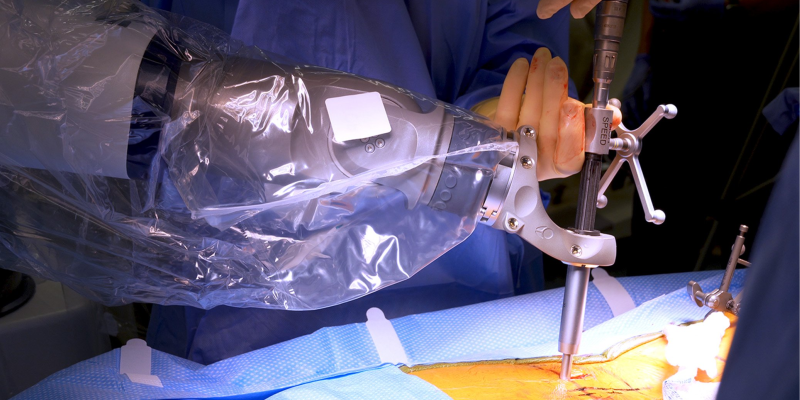
Robotic-assisted neurosurgery is one of the most significant advances in modern medicine — combining robotic precision, real-time imaging, and AI-guided navigation to help surgeons operate with accuracy that exceeds the natural limits of the human hand.
The human brain tolerates virtually zero margin for error. Eloquent cortex — the regions controlling speech, motor function, and memory — can lie just millimeters from a tumor. A tremor as small as a fraction of a millimeter can mean the difference between a full recovery and a permanent neurological deficit.
Robotic neurosurgery systems do not replace the surgeon. Instead, they act as an extraordinarily stable, tireless extension of the surgeon's hands — filtering out physiological tremor, translating movements into scaled-down precision actions, and holding positions with zero drift for as long as required.
"The robot does not replace the surgeon — it amplifies the surgeon's intent, filtering out human limitation while preserving human judgment."
As a neurosurgeon in Kochi practising at Aster Medcity, Dr. Anup P Nair incorporates navigation-guided techniques, real-time imaging, and minimally invasive approaches into complex brain and spine procedures — reflecting the same principles that define robotic neurosurgery at its best.
This article covers how robotic-assisted neurosurgery works, the leading platforms in clinical use, applications in both brain and spine surgery, patient outcomes, current limitations, and what the next decade holds for this rapidly evolving field.
Robotic-assisted brain and spine surgery relies on four integrated technology components working in concert. Understanding these components helps explain why robotic systems consistently outperform freehand technique in accuracy-critical procedures.
Surgical robotic arms use multi-axis articulation and force-feedback tremor filtering to translate the surgeon's macro-scale movements into sub-millimeter precision inside the surgical field. This is particularly critical in minimally invasive and keyhole spine surgery, where working corridors may be just a few millimetres wide — a technique central to advanced spine care in Kochi and globally.
Neuronavigation integrates real-time MRI and CT data to create a live 3D map of the patient's brain or spine. Instruments are tracked against this map with GPS-like accuracy, allowing surgeons to target structures deep within the brain that would be unreachable safely without guidance.
Fluoroscopy, intraoperative ultrasound, and intraoperative MRI provide continuous tissue feedback during the procedure. The surgical map is updated in real time as tissue shifts, blood redistributes, or the target moves — ensuring the robot's guidance remains accurate throughout.
AI surgical planning software analyzes preoperative imaging to suggest optimal instrument entry trajectories, flag critical anatomical structures, and model risk zones before the first incision is made. This reduces intraoperative decision burden and supports safer outcomes.
Several robotic platforms have received regulatory clearance and are in active clinical use worldwide. The choice of system depends on the procedure type, the surgical specialty, and the institution's infrastructure.
ROSA Brain is widely used for stereotactic procedures, deep brain stimulation (DBS), and SEEG electrode placement for epilepsy surgery. It integrates directly with MRI data for trajectory planning and achieves sub-millimeter targeting accuracy at depths beyond 10 cm.
Designed for neurovascular and tumor resection surgeries, BrightMatter combines intraoperative MRI with a robotic microscope arm that maintains continuous focus on the surgical field — enabling real-time visualization during delicate resections.
NeuroArm is the world's first MRI-compatible surgical robot, capable of operating inside an active MRI scanner. This allows real-time soft tissue imaging during procedures — a level of intraoperative feedback unavailable with conventional surgical robots.
Robotic spine surgery reached a new benchmark with the Mazor X Stealth Edition, which pairs robotic guidance with Medtronic's Stealth Navigation platform. It is the most widely adopted system for robotic pedicle screw placement and complex spinal reconstruction.
The Excelsius GPS platform uses image-guided robotics to assist with pedicle screw placement and spinal stabilisation procedures. Clinical studies report screw accuracy rates significantly superior to conventional freehand technique.
Robotic-assisted brain surgery is transforming outcomes across a wide range of cranial procedures. The consistent sub-millimeter accuracy of robotic systems makes previously inoperable cases surgically approachable.
Robotic spine surgery delivers some of the most clearly measurable improvements in any surgical subspecialty. Pedicle screw misplacement is a leading cause of revision surgery — robotic guidance addresses this directly.
"Robotic-assisted pedicle screw placement achieves accuracy rates above 98% — compared to approximately 90–94% with conventional freehand fluoroscopy technique."
The clinical evidence for robotic neurosurgery is increasingly robust. Across both brain and spine procedures, robotic-assisted approaches consistently demonstrate measurable advantages over conventional technique in complication rates, accuracy, and recovery. These outcomes are why leading neurosurgeons — including spine specialists at centres like Aster Medcity Kochi — are integrating navigation-guided and minimally invasive techniques into their surgical practice.
Despite its clinical promise, robotic-assisted neurosurgery faces real barriers to widespread adoption. Understanding these limitations is important for both clinicians evaluating the technology and patients researching their options.
The future of robotic neurosurgery is shaped by four converging technology trends: artificial intelligence, miniaturisation, haptic engineering, and remote connectivity. Together, these will fundamentally expand what is surgically possible over the next decade.
Machine learning models trained on thousands of annotated surgical cases will provide real-time anatomical alerts, risk scoring, and trajectory recommendations during active procedures — functioning as a continuously vigilant second opinion.
Force-sensing end-effectors will transmit tissue resistance data back to the surgeon's hands, restoring the tactile sense currently absent from robotic systems and enabling more nuanced intraoperative tissue discrimination.
Endovascular robotic neurosurgery represents one of the most exciting frontiers. Micro-robots navigable through the cerebrovascular tree will enable minimally invasive treatment of brain aneurysms, arteriovenous malformations, and targeted intracranial drug delivery without open craniotomy.
Robotic telesurgery — enabled by low-latency 5G and satellite networks — will allow specialist neurosurgeons to operate on patients thousands of kilometers away. This has transformative implications for surgical access in rural and low-resource settings.
Robotic systems may eventually execute precisely bounded sub-tasks — including bone drilling, dural opening, and electrode insertion — autonomously under surgeon supervision. This would allow the human surgeon to focus exclusively on the highest-complexity, highest-judgment phases of a procedure.
Is robotic neurosurgery safer than traditional neurosurgery?
For many procedure types, yes. Robotic-assisted systems consistently demonstrate higher accuracy rates, lower complication rates, and reduced revision surgery requirements compared to conventional freehand technique — particularly for pedicle screw placement in spine surgery and electrode implantation in brain surgery.
How long does a robotic neurosurgery procedure take?
Robotic procedures typically add 15–30 minutes of setup time compared to conventional approaches. However, for complex multi-level spine surgeries or multi-electrode brain implantation procedures, the efficiency of robotic guidance often reduces total operative time significantly.
Is robotic brain surgery available at most hospitals?
Not yet. Robotic neurosurgery is currently concentrated in major academic medical centers and well-resourced tertiary hospitals. Adoption is growing but is limited by the high cost of robotic platforms. In Kerala, advanced brain and spine surgery — including navigation-guided and minimally invasive procedures — is available at specialist centres such as Aster Medcity Kochi. Patients should ask specifically whether their neurosurgeon uses navigation tools and minimally invasive techniques for their procedure.
Does robotic neurosurgery mean the robot performs the operation?
No. In all current robotic neurosurgery systems, the surgeon remains in complete control of every clinical decision. The robot does not operate independently. It acts as a guided, stable tool that improves the accuracy of the surgeon's actions.
What types of brain conditions can be treated with robotic surgery?
Robotic-assisted approaches are currently used for brain tumor resection, deep brain stimulation for Parkinson's disease and essential tremor, epilepsy surgery (SEEG), stereotactic biopsy of deep lesions, and radiosurgery planning for tumors and vascular malformations.
Robotic-assisted neurosurgery is transforming outcomes across the full spectrum of brain and spine procedures. By extending the surgeon's precision beyond what the human hand alone can achieve, robotic systems are making previously inoperable cases accessible, reducing complications, and accelerating patient recovery.
The technology is not without limitations — cost, haptic feedback, and global access remain real challenges. But the trajectory is clear: as these barriers are addressed, robotic neurosurgery will transition from a specialised capability to a standard of care.
If you are looking for an experienced neurosurgeon in Kochi for a brain or spine condition, Dr. Anup P Nair — Senior Consultant Neurosurgeon at Aster Medcity Kochi — offers expert guidance on minimally invasive spine surgery, keyhole brain surgery, deep brain stimulation, and spinal deformity correction. He also consults at Medcare Hospitals in Dubai and Sharjah for patients in the Middle East.
Have a spine or nerve concern? Connect
with Dr. Anup P Nair for clear and personalized guidance.